

Increase AI development efficiency.
Organizations are buying coding agents and rebuilding the SDLC around them. Developers using those agents get probabilistic results that need reworking, and they pay for every attempt in tokens.
Agents spend most of their tokens on discovery,
not on writing code.
An agent loop runs in four phases: discover, plan, act, and review. Only act writes code, and it gets about a fifth of the budget. Discovery and planning come first, so 75% of the token budget is gone before the agent writes a line. The loop then repeats: every task, every iteration.
Agents need code search that understands symbols,
not just strings.
Coding agents spend most of their time searching. Before an agent writes anything, it greps and globs for names and files, and it keeps looping until it finds them. Every one of those searches costs tokens. Then it reads the files and the binary dependencies and infers what the code actually means.
Trigrep builds its index from the Lossless Semantic Tree, so the agent can query structure, types, symbols, and dependencies instead of guessing at them from text. The index is built once and updated incrementally, so Trigrep answers at close to constant speed whatever the size of the codebase. Grep scales linearly, reading every line every time.
Prethink gives coding agents and organizations semantic
code context.
Prethink is a recipe that pulls data out of the LSTs and writes it back as data tables covering dependencies, APIs, architecture, code quality, and test metrics. It runs deterministically at no token cost, and you can extend it to capture your own internal frameworks and architectural patterns.
Dropped into a repository, it lets an agent query for what it needs instead of rereading files and dependencies to rebuild the same picture every session. As new code lands, the agent gets immediate feedback on code quality and test coverage.
Aggregate that context centrally across every repository and you get a view of the estate that no agent could assemble on its own. An agent working in one repo can pull from it too, reading organization-wide architecture practices, the dependencies already in use, and where each API is called, so it knows how to evolve an application that spans many repositories.
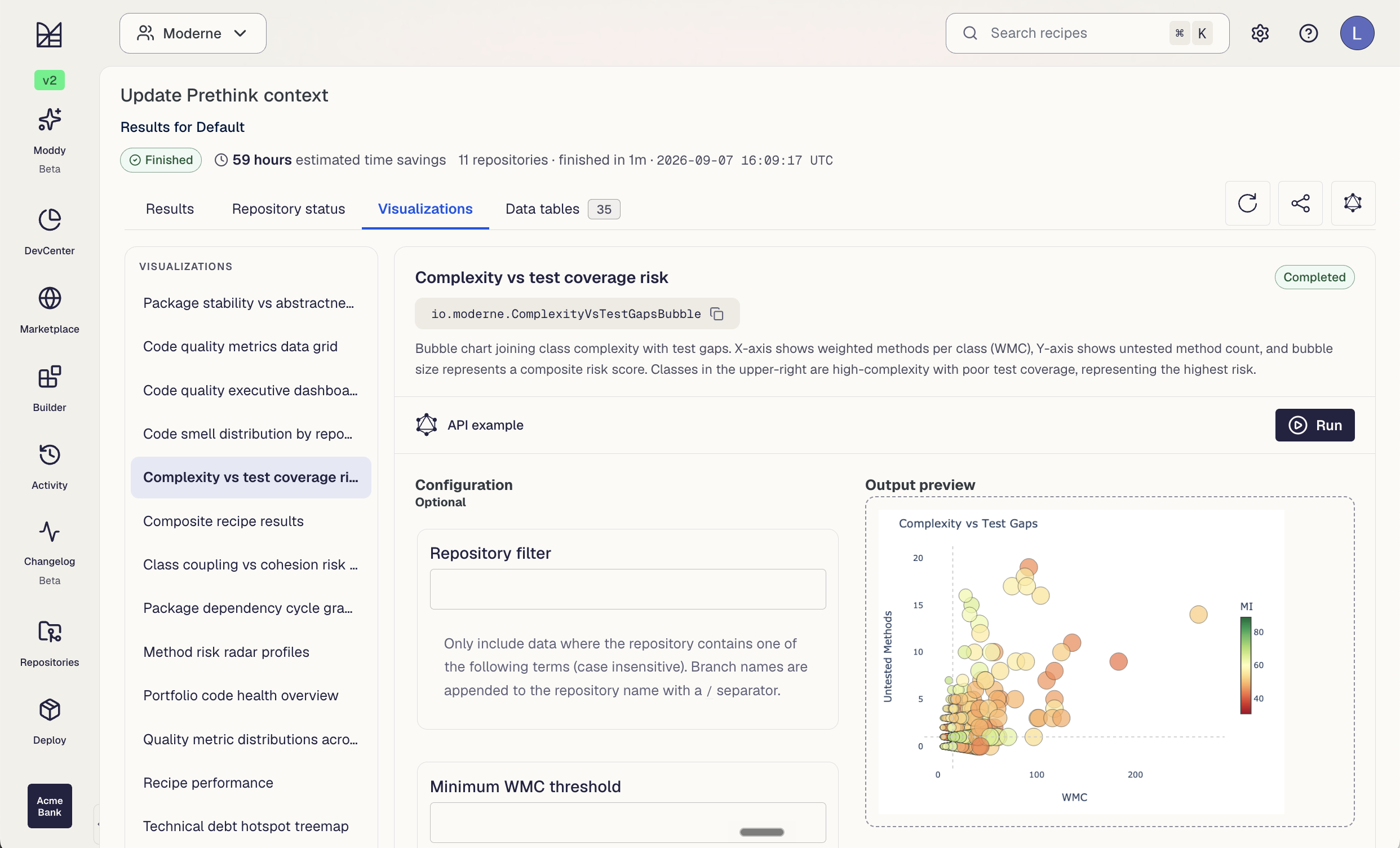
Every Prethink run produces data tables, and every data table can become a chart. This one joins complexity with test gaps across 11 repositories, so a team can see which classes carry the most risk before anyone opens a file.
Recipes
One recipe builds the context, across every language in the repository at once.
- Generate CALM architectureA FINOS CALM architecture model of the repository, as JSON.
- Find CALM relationshipsMethod-to-method calls between in-repo classes, for the interaction diagrams.
- Find external service callsOutbound HTTP calls through RestTemplate, WebClient, Feign, Apache HttpClient, OkHttp, and JAX-RS clients.
- Find service endpointsSpring MVC, JAX-RS, Micronaut, and Quarkus REST endpoints, including those declared on interfaces.
- Find Django endpointsPython services mapped by route and handler.
- Find Express endpointsNode and JavaScript routes, middleware, and handlers.
- Find ASP.NET Core endpointsControllers, minimal APIs, and route attributes across C# projects.
- Find Go service endpointsGo HTTP and service entry points.
- Find Rails endpointsRuby routes expanded through namespace, scope, and concern nesting.
- Find data assetsJPA entities, MongoDB documents, records, DTOs.
- Find method complexityCyclomatic and cognitive complexity, nesting depth, parameter count, ABC and Halstead measures.
- Find code smellsGod Class, Feature Envy, and Data Class, scored against composite metric thresholds.
- Find duplicate codeExact, renamed, and gapped clone groups, ranked by how much code would collapse. No AI involved.
- Find test coverage gapsUntested public methods, ranked by complexity and risk.


Hand the agent structured context, and the same work finishes in a fraction of the tokens.