Language support Spring Boot

Move every Spring Boot service from 2.x to 4.x in one coordinated run.

Spring Boot version upgrades, Jakarta namespace migration, Spring Security modernization, and Java 17/21/25 alignment across hundreds of services.

Why Spring Boot at Moderne

Spring Boot upgrades that survive a polyglot estate.

Spring Boot upgrades break consistently and quietly. Recipes coordinate the change across every service that depends on the framework.

Compiler-accurate by default.

Every Spring annotation, configuration class, and bean wiring lands in the Lossless Semantic Tree. Recipes resolve symbols across modules instead of pattern-matching strings.

Recipes cover the full upgrade path.

Pre-built recipes cover Spring Boot version jumps, Jakarta namespace shifts, Spring Security modernization, configuration property migration, and dependency alignment.

One coordinated run, hundreds of services.

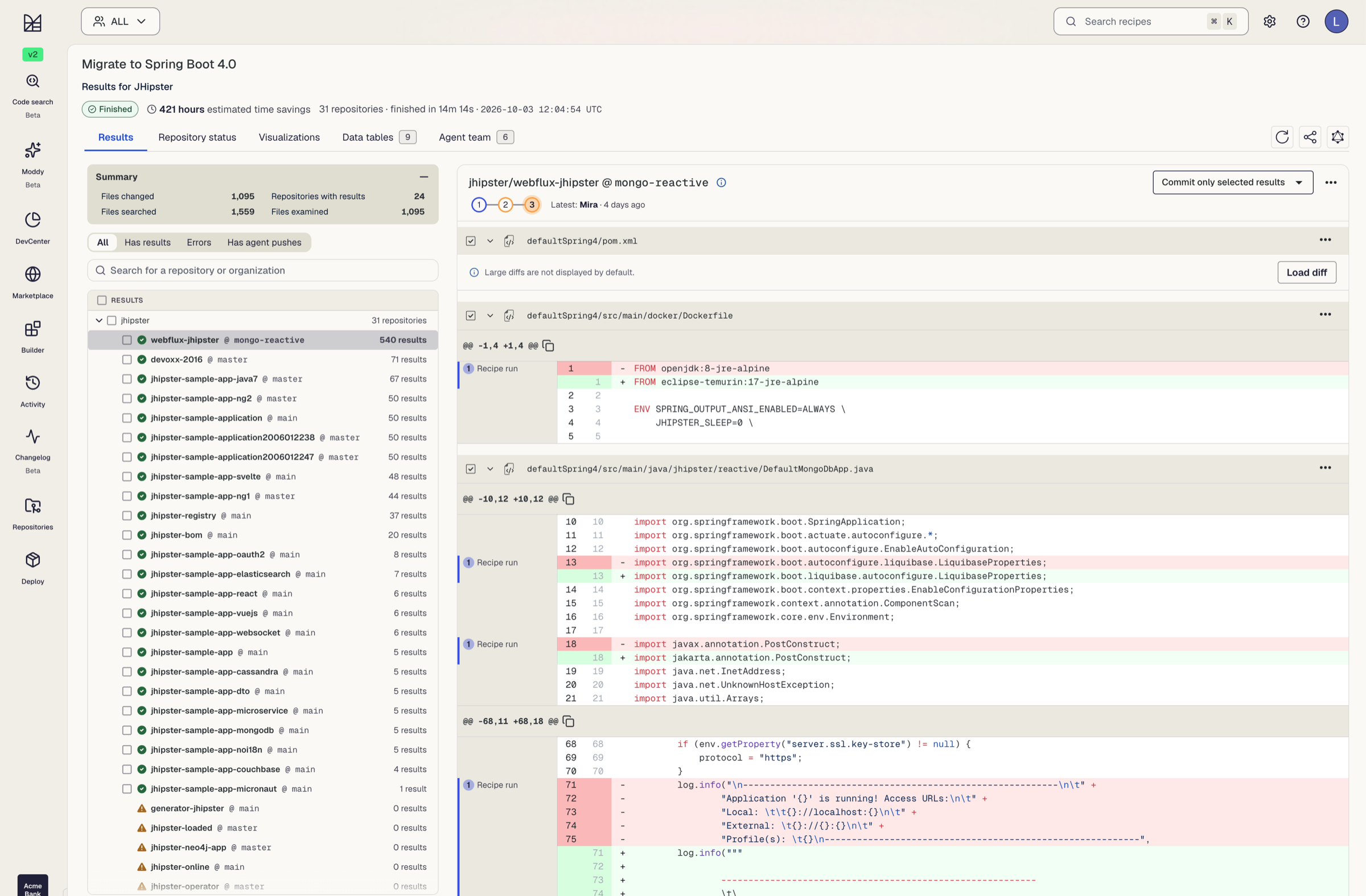
A single recipe execution opens pull requests across every Spring Boot service in the estate. No per-team sequencing, no migration script per repo.

What you can migrate

Concrete Spring Boot migration paths.

Version ranges and recipes verified against the live solution page and docs.moderne.io.

Version upgrade

Spring Boot 2.x → 3.x

The big jump. Jakarta namespace migration, Spring Security 6, configuration property renames, and removed APIs.

Version upgrade

Spring Boot 3.x → 4.x

Latest major. Recipes target the API changes, dependency alignment, and configuration shifts between 3.x and 4.0.

Framework

javax → jakarta

Jakarta EE namespace migration across imports, dependencies, and APIs. The canonical Spring Boot 3 prerequisite.

Framework

Spring Security modernization

Lambda DSL adoption, removed APIs, and authentication configuration changes through Spring Security 6.

Version upgrade

Java alignment (17 / 21 / 25)

Recipes coordinate the Java version upgrade alongside the Spring Boot jump so language features and dependency baselines stay aligned.

Configuration

application.properties migration

Renamed and removed configuration properties updated across application.properties and application.yml files.

Dependencies

Third-party dependency updates

Spring-module and third-party dependency versions aligned to the target Spring Boot baseline, with transitive resolution.

Tests

JUnit 4 → JUnit 5

Annotation mapping, lifecycle conversion, and Maven or Gradle dependency updates run alongside the framework upgrade.

Our developers now spend less time worrying about legacy code and more time focusing on value-driven work.
Jason Simpson VP of Engineering, Choice Hotels Read the case study

How it works

Three steps, every language.

  1. Ingest the LST.

    Moderne parses every Spring Boot service across every repo into a Lossless Semantic Tree. Annotations, beans, configuration, and dependency declarations are preserved.

  2. Run the recipe.

    Recipes execute against the LST. Version upgrades, namespace shifts, and security migrations apply deterministically across every affected file.

  3. Review and merge.

    Reviewable pull requests open across every service touched. Your team merges. Moderne tracks coverage and progress portfolio-wide.

Questions

Spring Boot migration, answered.

For most teams, automation via semantic code transformations is more effective than manual repo-by-repo upgrades. Spring Boot 3.x introduces significant framework updates including Jakarta EE namespace shifts, difficult to apply consistently by hand at scale. Manual upgrades break down due to inconsistent baselines, shared libraries, and varying test coverage.

Stepwise or multi-version upgrades support forward-looking approaches. Enterprises benefit from tools enabling incremental migration while maintaining portfolio visibility, reducing risk versus one-time large migrations.

Centralized governance with team-level autonomy. Define standardized migration rules, allow individual teams to review/merge via pull requests. Automated platforms apply upgrade logic consistently across repositories while preserving ownership and review.

Yes, when automation uses semantic code understanding rather than text-based search/replace. Semantic engines like OpenRewrite analyze code structure directly, enabling safe migrations validated through existing test suites.

Yes. Jakarta migrations involve widespread, consistent API and package changes — ideal for automation. OpenRewrite provides dedicated recipes automatically updating imports, dependencies, and APIs.

Automation compresses timelines from years to months or weeks for prepared teams, versus multiple years for manual repo-by-repo approaches.

Get started

Move Spring Boot once. Then stay on the supported branch.
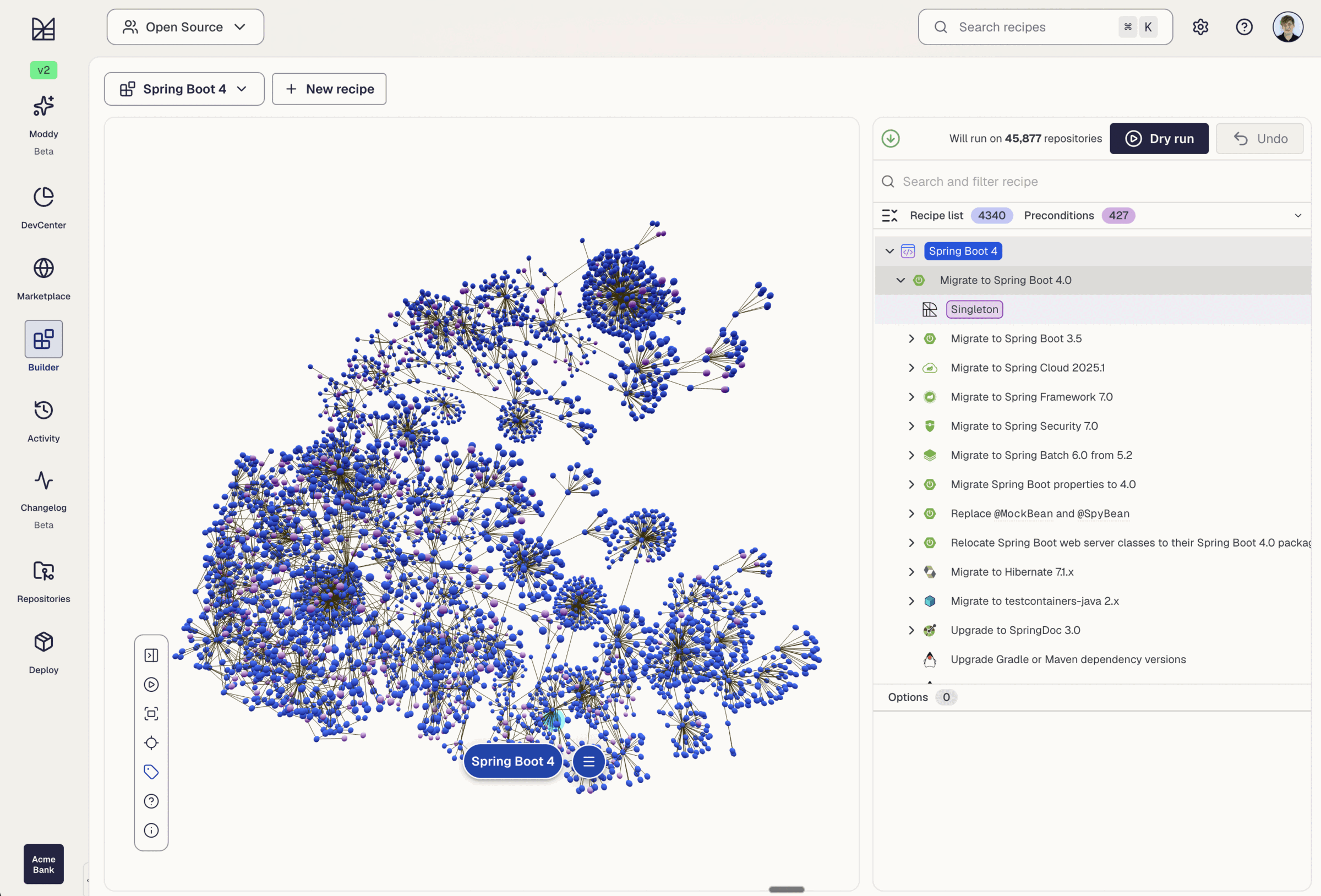
Recipes lock in the upgrade. Future version jumps run on the same engine, on the same review workflow.